

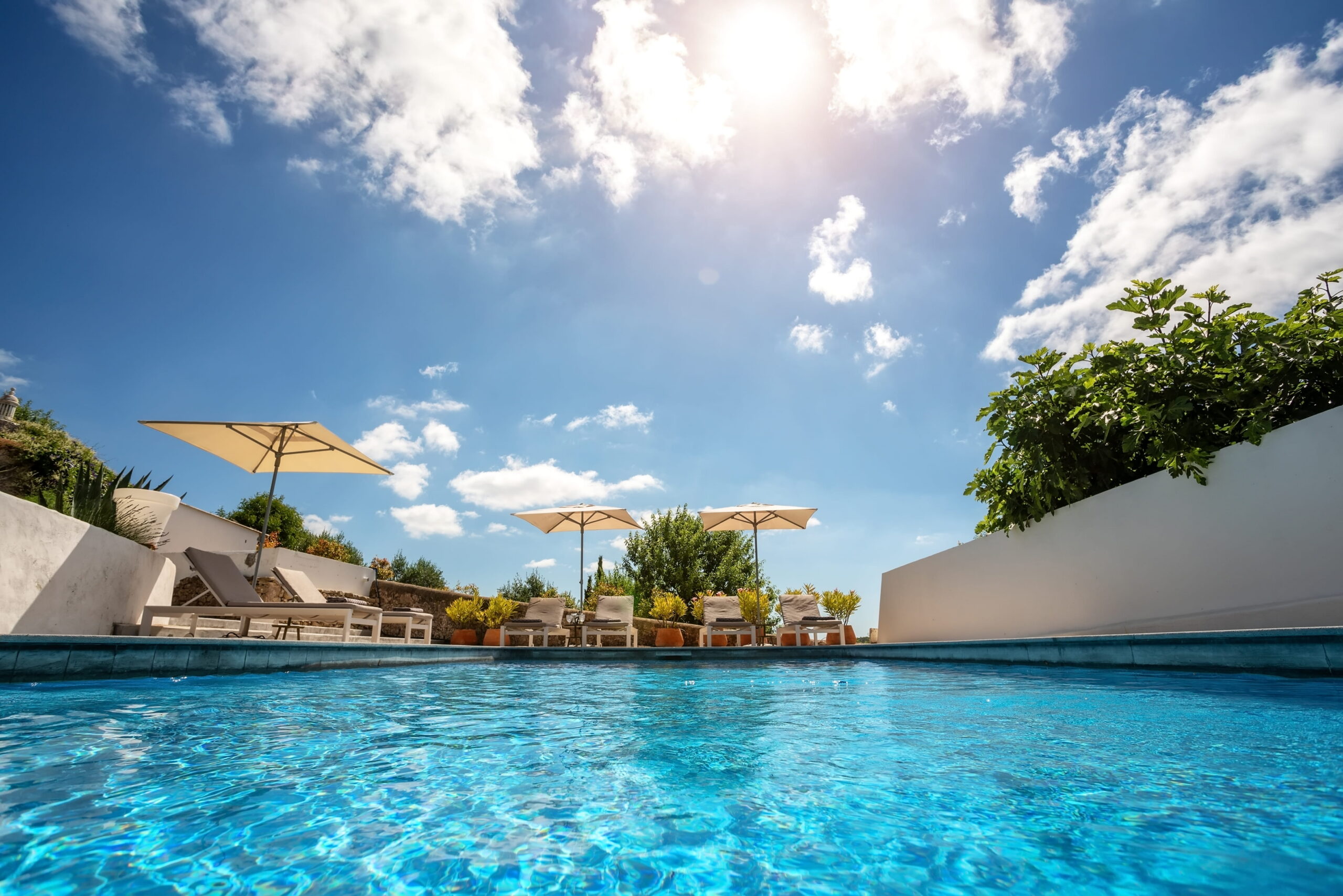
How the Texas Heat Affects Your Pool Chemistry
If you live in Texas, you know that June isn’t just the start of summer—it’s the start of a battle. It is the month when the morning air stops being “crisp” and starts feeling like a warm, wet blanket. While we are all busy firing up the grill or looking for the strongest air conditioning we can find, our swimming pools are out there in the backyard, baking under a relentless sun.
Most folks think that as long as the water looks blue, everything is fine. But here’s the reality: the Texas heat is a silent predator when it comes to pool chemistry in hot weather. You can go from a crystal-clear oasis on Friday to a swampy, pea-green mess by Sunday evening if you aren’t careful. Understanding why this happens—and how to stop it—is the difference between a relaxing summer and a season spent dumping hundreds of dollars into “pool shock” and algaecide.
Let’s dive into the science of why the heat makes summer pool maintenance so much more difficult and what you can do to keep your water balanced when the thermometer starts flirting with triple digits.
Why Chlorine Disappears Faster
You might feel like you’re pouring liquid gold into your pool lately, only for it to vanish into thin air. You aren’t imagining things. In North Texas, the sun is a literal “chlorine thief.” When we talk about chlorine loss in pool water, we are usually looking at two main culprits: the sun’s ultraviolet (UV) rays and the people actually using the pool.
The UV Exposure Factor
Think of chlorine as a soldier. Its job is to seek out and destroy bacteria, viruses, and organic matter. However, UV light from the sun has a way of breaking apart the chemical bonds of chlorine molecules. Without a “sunscreen” for your chlorine—scientifically known as Cyanuric Acid (CYA) or stabilizer—the Texas sun can actually destroy up to ninety percent of your pool’s chlorine in just a couple of hours.
Even if you have the proper amount of stabilizer, the sheer intensity of a June afternoon in Dallas or Austin is enough to deplete your sanitizer levels faster than any other time of year. This is why you might test your water at 8:00 AM and see a perfect reading, but by 5:00 PM, your kit shows zero.
The “Swimmer Load” Reality
Then, there is the human element. When it’s a hundred degrees outside, everyone wants to be in the water. We love having the kids, the neighbors, and the dogs in the pool, but each person who jumps in brings a “gift” of organic contaminants. We’re talking about sweat, body oils, hairspray, and—the biggest offender—sunscreen.
Chlorine has to work overtime to “burn off” these contaminants. The more people you have in the water, the faster that chlorine is used up. During a heavy-use summer weekend, your chlorine is being pulled in two directions: it’s fighting the sun, and it’s fighting the sweat. If you don’t stay on top of it, the “demand” for chlorine will eventually outweigh the supply, and that is when the water starts to get cloudy.
Higher Temperatures = Faster Algae Growth
If you’ve ever left a container of leftovers in a warm car, you know that heat accelerates growth. The same principle applies to your backyard. Hot weather pool care is essentially a race against biology.
Why Algae Thrives in Heat
Algae is a plant, and like most plants, it loves two things: sunlight and warmth. When your pool water temperature climbs into the high eighties or low nineties (which happens easily in a Texas June), your pool basically turns into a giant petri dish.
Warm water provides the perfect environment for algae spores to germinate and multiply. In cooler spring water, algae grows slowly, giving you plenty of time to catch it. But in the heat of summer, algae can double its population in a matter of hours. This is why you’ll often see a “mustard algae” or “green film” appearing on the shady side of the pool or behind the ladder first. Once it takes hold in warm water, it becomes incredibly resilient, often requiring triple the normal amount of shock to kill it off.
Furthermore, warm water holds less dissolved oxygen than cool water. This shift in the environment makes it even easier for certain types of blooms to take over. If your chlorine levels dip even slightly while the water is ninety degrees, you are essentially rolling out the red carpet for an algae infestation.
Increased Chemical Demand
It isn’t just about the chlorine, though. The heat triggers a chain reaction that affects your entire pool water balance. Everything from your pH to your Total Alkalinity starts to shift when the temperature rises.
The Struggle with pH Balance
In the heat of summer, we often see pool pH levels start to creep up. This happens for a few reasons. First, as we discussed in the previous blog, evaporation is high in the summer. When water evaporates, it leaves behind minerals and salts, which can cause the pH to rise.
Second, if you have water features like waterfalls or bubblers running to keep the pool cool (through aeration), that process actually “outgasses” carbon dioxide from the water. When CO2 leaves the water, the pH goes up.
Why does this matter? Because chlorine is extremely “lazy” in high-pH water. If your pH gets above 7.8, your chlorine is only about half as effective as it would be at 7.4. You could have plenty of chlorine in the water, but if the pH is off, that chlorine won’t be able to kill bacteria or algae. You’re essentially wasting money on chemicals that can’t do their job.
Total Alkalinity and Scaling
As the water evaporates and you “top off” the pool with a garden hose, you are introducing “hard” Texas tap water into your system. This can cause your Total Alkalinity and Calcium Hardness to spike. When the water gets too hot and the mineral content gets too high, you start seeing “scale”—that white, crusty buildup on your tiles and inside your salt cell. This makes your pool look old and can eventually damage your heater and pump.
Why Weekly Testing Matters
In the winter, you can get away with testing your water once every two weeks. In the Texas summer? That’s a recipe for disaster. Summer pool maintenance requires a much more “hands-on” approach.
Staying Ahead of Problems
The goal is to be proactive rather than reactive. If you only test your water on Saturdays, and your chlorine bottomed out on Tuesday, you’ve given algae four full days to build a colony in your pipes and plaster. By the time you notice the water is “a little dull,” the bill to fix it has already doubled.
I always tell homeowners that in June, July, and August, you should be doing a quick “dip test” every other day. You don’t necessarily need to do a full chemistry workup, but you should at least check your free chlorine and pH levels.
Professional Help and Automation
If you find that you can’t keep up with the demand, this is the time of year to consider professional service or investing in a salt-water chlorine generator. These systems provide a “trickle” of chlorine into the pool constantly, which helps prevent those dangerous “dips” in sanitizer levels that happen between manual dosings.
But even with the best equipment, nothing beats a manual check. Take five minutes after work to test the water. If the chlorine is low, add a little. If the pH is high, add some muriatic acid. Those small, five-minute adjustments prevent the “Green Monster” from taking over your backyard.
Keep Your Pool Balanced
Texas summers are legendary for a reason—they are tough on people, tough on lawns, and especially tough on pool water. The combination of scorching UV rays, warm water temperatures, and high swimmer loads creates a “perfect storm” that can wreck your pool water balance in a heartbeat.
But don’t let the heat discourage you. By understanding how the sun affects your chemicals and staying diligent with your testing, you can keep your water safe, clear, and inviting all summer long. Keep your pool balanced as temperatures climb. Don’t wait for the water to turn cloudy before you take action. A little bit of attention today means a lot more swimming tomorrow. Grab your test kit, check those levels, and enjoy the water—you’ve earned it!